The trek itinerary is 8 days ascending and 4 days descending. Add on a few days of travel to and from Nepal and it’s a package you can just about fit into a 2 week break from work. However, we thought it would be more interesting to give ourselves an acclimatisation week in Kathmandu before we started the trek – and we’re glad we did.
Our flight from Heathrow to New Delhi was uneventful and full of – understandably – Indian people. We had a couple of hours in New Delhi airport before our connecting flight. We headed for our next departure gate which was almost exclusively full of Europeans wearing walking boots and North Face jackets. Our first indication of the trekkers’ paradise to which we were heading.
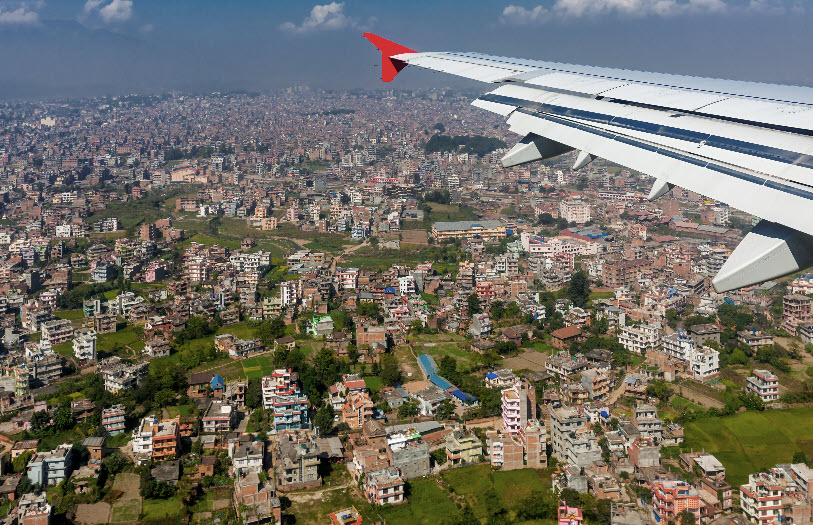
After a short 2 hour flight I got my first sight of Nepalese countryside. And it was unlike any other country I have gazed down on. The outskirts of Kathmandu were dotted with little two or three-storey houses looking like little cubes scattered around the farmland. Not many of the buildings appeared to be finished.
Arrival at KTM is frenetic. You are firmly entering the third world. Nepal is one of the poorest countries on earth and its international airport is rather like a 1960s UK bus station.
Those in the know virtually sprinted off the plane and headed directly for the visa desk to pay for their tourist visa. The rest of us staggered off the plane and tried to figure out what to do next. It took us a while to realise we had to fill in some forms and then buy a tourist visa. The clever ones started to queue and filled in the forms in the queue. The rest of us filled in the forms and then started to queue. About 90 minutes later we had our visa. Then we queued for immigration and then we queued for our luggage. Our alarmingly inexpensive hotel had promised an ‘airport transfer’, and in return we had told them what flight we would be arriving on. So we were expecting to see somebody dressed like a chauffeur holding a board with our name on it and then to be whisked into the city in air-conditioned limousine splendour. There was no board, no chauffeur and no limo. Nerves were, by this time, beginning to fray as we were accosted by porters/taxi-drivers/beggars/hotel touts etc. We changed some money at an ATM and opted for a taxi and gave them the name of our hotel. They had not heard of it. Hmmm.
Ok – let’s talk about the hotel. Several months’ earlier we had tackled the subject of which hotel we would like to stay in. Kathmandu has the usual Holiday Inn style offerings, but we both agreed we wanted to experience the real Kathmandu rather than a bland sanitised western-world hotel with an in-room trouser press and sachets of hot chocolate.
So we had chosen the Blue Mountain Home Stay. It sounded charming…
“Guests can choose from 11 rooms, all of which exude an atmosphere of total peace and harmony. The hotel’s garden are ideal places to relax and unwind after a busy day. Blue Mountain Home Stay is an ideal place of stay for travelers seeking charm, comfort and convenience in Kathmandu.”
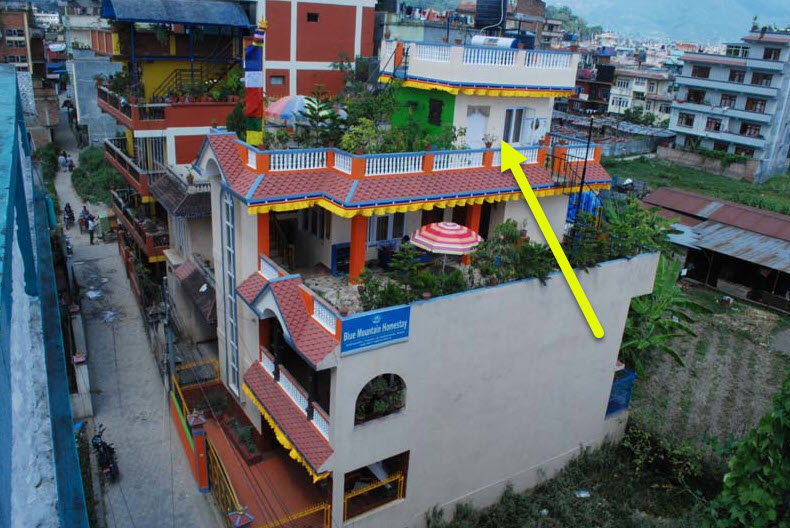
The clincher … it was only £9 per night – including breakfast – bargain! And even the photo looked nice. We booked the ‘Deluxe Rooftop’ room – highlighted by the yellow arrow below. What a tropical haven this would prove to be. Hah, Holiday Inn – in your face!
Our taxi eventually found it and we presented ourselves at “Reception” – which was a table in the garden. Never mind, the delights of rest in our very own Shangri-La were only minutes away. Jet-lag was by now starting to bite.
We showed the owner our reservation for the room – which we had dutifully printed-off. He peered at it closely and shook his head. “You cannot have this room” he said. “Why not?” we asked. “People are staying in this room” he said. “Yes … we are” we stated – fully aware of our consumer rights.
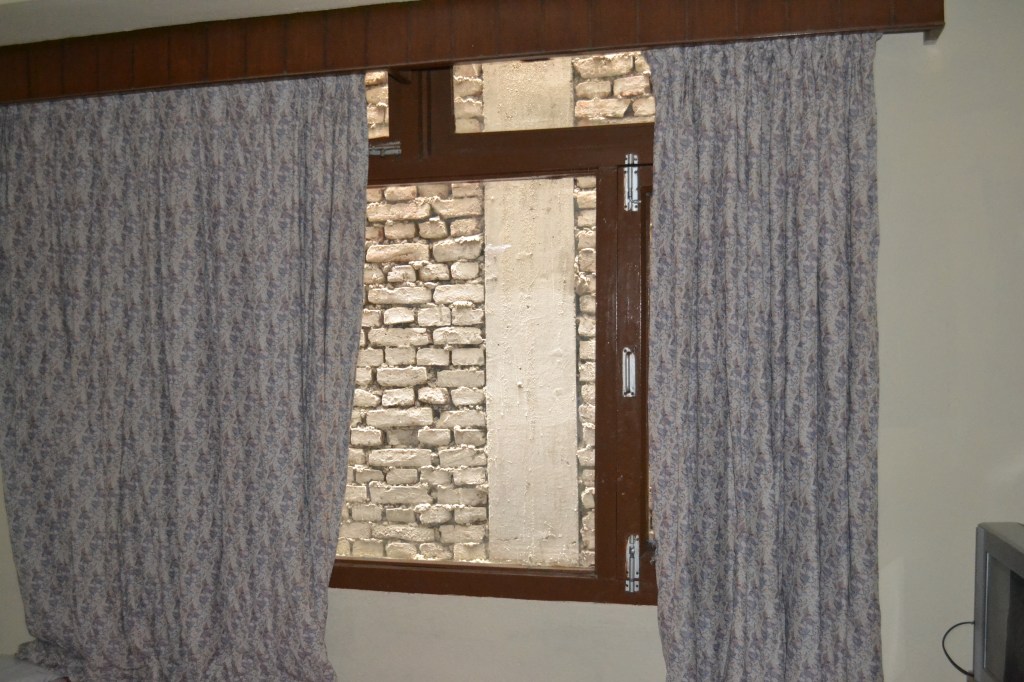
It was only when we insisted on seeing the room, which contained another couple’s suitcases, clothes, toiletries etc. that we were convinced our consumer rights were being trampled on and there was nothing we could do about it. The owner said he owned another hotel – “much nicer than this one” which (remarkably) had a room we could stay in for the week – AT NO EXTRA COST! Well what a bargain. In our frazzled state we accepted the kind offer – we had no choice – and he took us there. We checked-in and went up to our room to collapse. The room was basic, but acceptable. I just wished I had not decided to open the curtains to admire the view – no doubt of the distant snow-capped Himalaya.
Here’s the actual view from our room.
The next day we moved to a marginally better room. But neither had a trouser-press 😦
Kathmandu is dirty, smelly, frenetic, disorientating, busy, noisy, confusing … and therefore interesting. We stayed in the main tourist area, Thamel with its narrow streets lined with hiking shops which sold all the western-branded goods, but at a fraction of the price. Hmm – I wonder how they do that.
We did find the North Face shop and we knew it was the real-deal selling genuine North Face kit because it had windows with glass in them and it had air conditioning. So we browsed in there on several occasions, but only to keep cool.
Another oasis we discovered was The Garden of Dreams. Whenever the bustle of the city became overwhelming we headed here. It is a tranquil walled garden and for a tiny entrance fee you can lie on the grass and try to shut out the not-so-distant traffic noise.
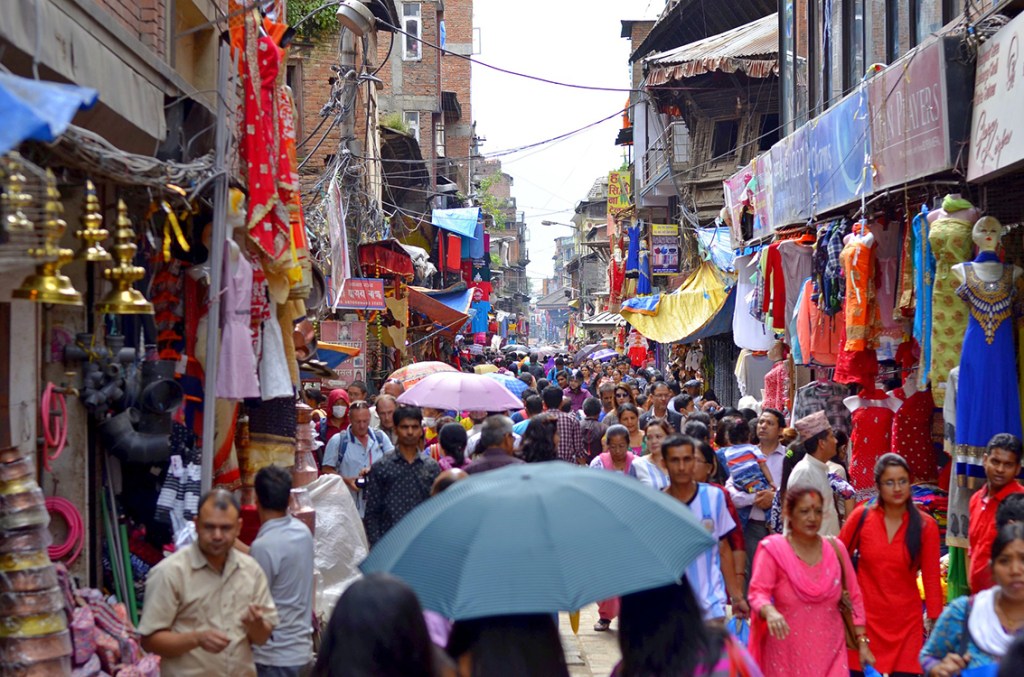
We had a fruitful week, getting to grips with Nepal and preparing for our adventure. One thing we had not brought from the UK was altitude sickness tablets. These were recommended, but when we talked to our GP about them he said we could have them prescribed, but it would cost £70! Well – I’d rather have a pulmonary oedema than spend £70. But in the back streets of Thamel we asked for some in a pharmacy. They reached under the counter and produced a couple of packs for about £2. Result! Who cares if they are just a placebo. At least they’re a cheap placebo.
Our biggest concern by far was avoiding Delhi-belly (or Kathmandu-poo). The very last thing we wanted was the runs when we were doing the walk. Our strategy was to avoid any meat, and only eat freshly-cooked stuff as much as possible. So we embarked on a diet of fried rice. We also sterilised all the water we drank, even if it came from sealed bottles. And it worked! We were healthy for our Kathmandu week and also on the trek, unlike some of our fellow trekkers, for whom we felt very sorry.
We spent our days wandering the streets and visited some of the city’s best sights. In fact, I think we visited all of them! On our first day we ventured on foot to Swayambhunath Stupa (aka the Monkey Temple), situated on top of a hill overlooking the city. Due to all the training Mary had done in the UK prior to leaving she fairly sprinted up these steps to the top.
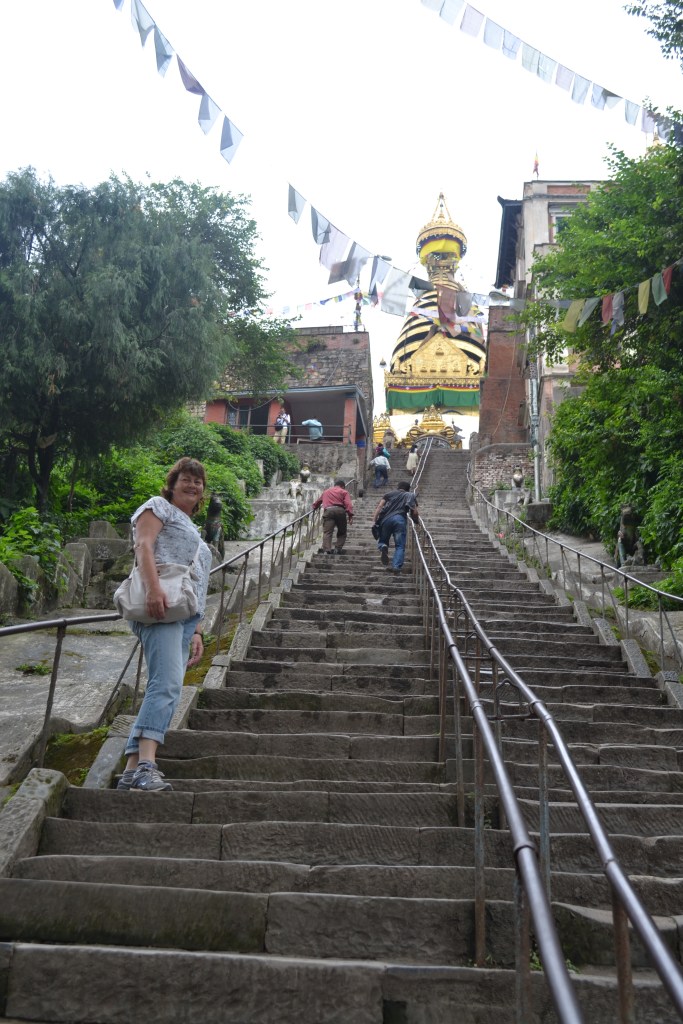
This was our fist stupa – a mound-like structure containing Bhuddist relics. We were to see hundreds in the next few weeks. It is very important you always walk round them in a clockwise direction with the stupa on your right.
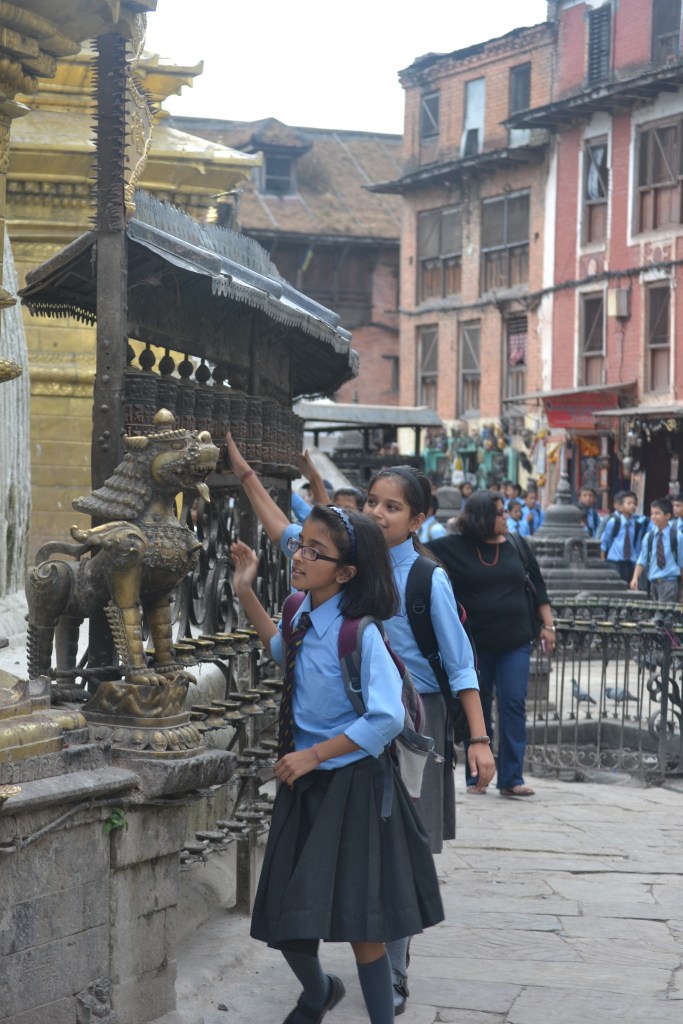
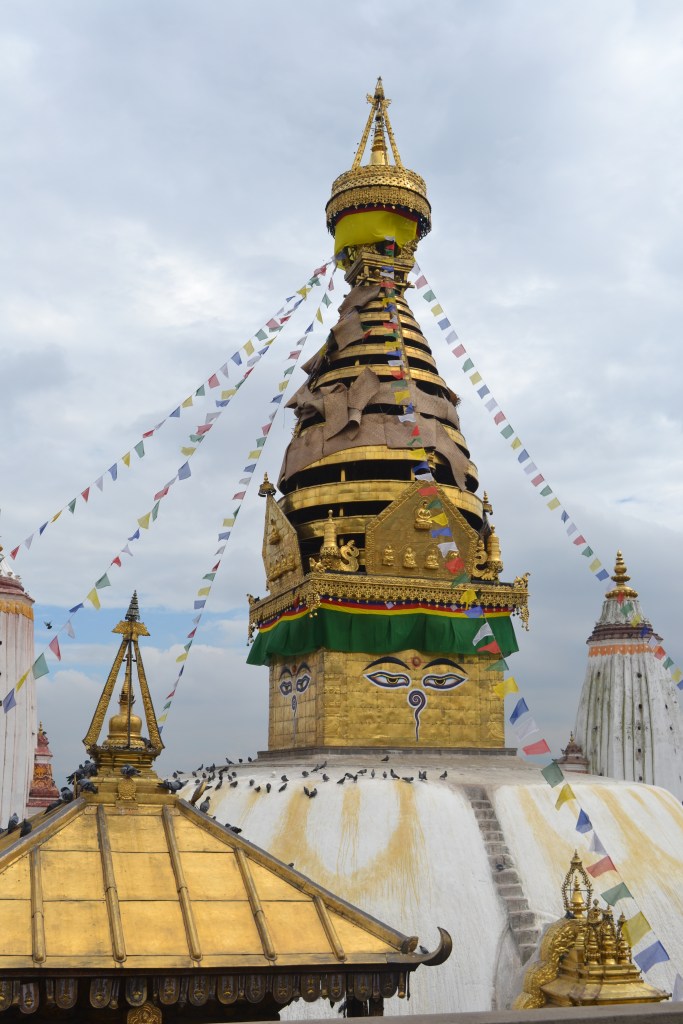
The dome at the base represents the entire world. The large pair of eyes on each of the four sides of the main stupa represent wisdom and compassion. The thirteen discs on the top symbolise the thirteen stages of spiritual realisations to reach enlightenment. All good stuff.
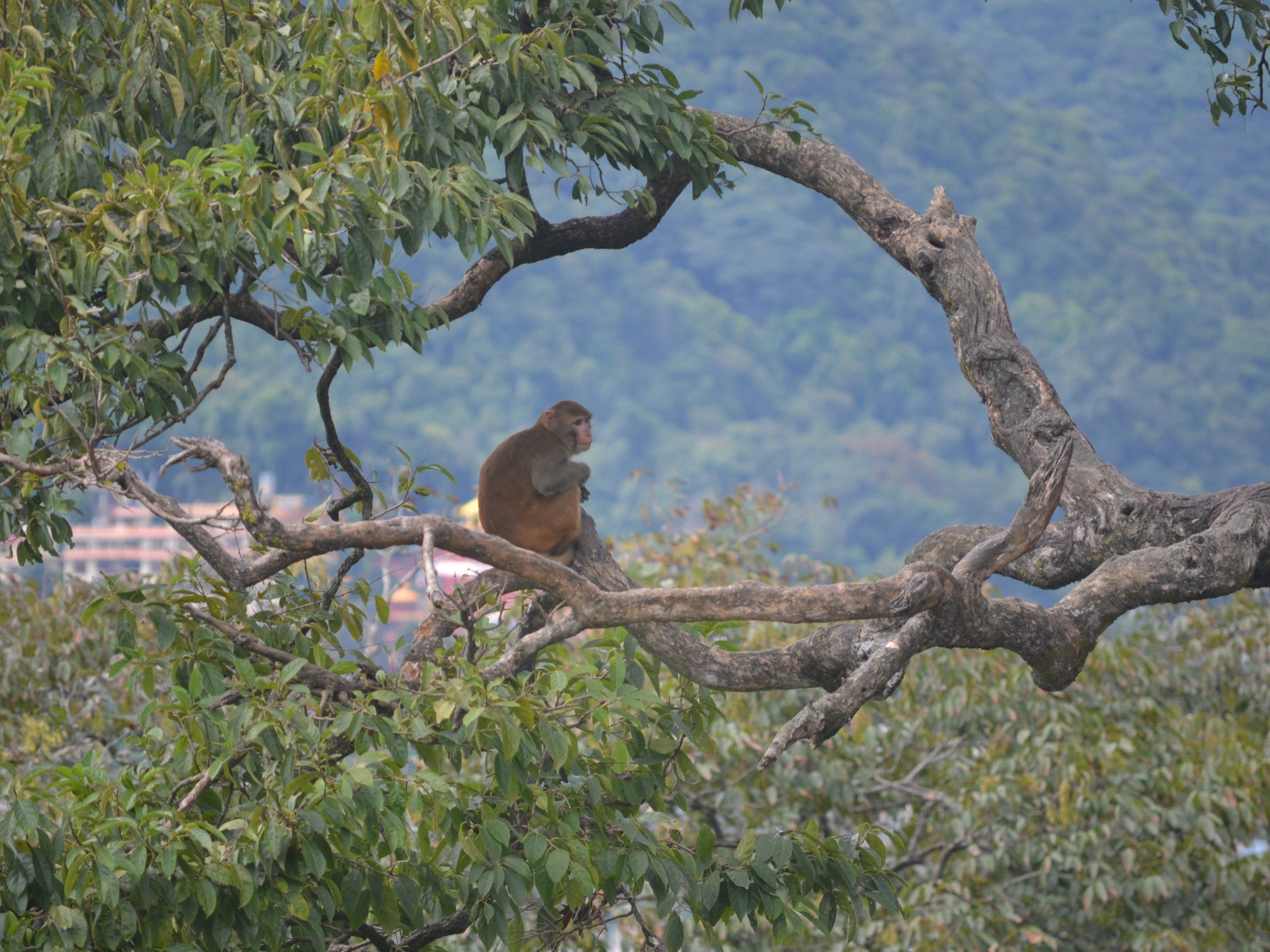
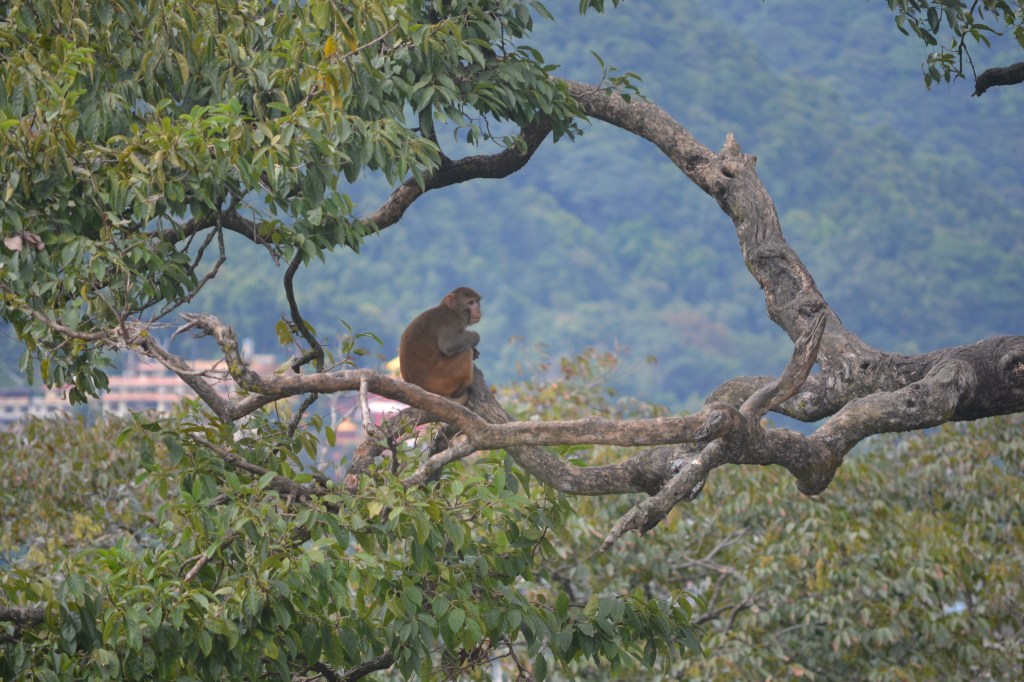
And the Monkey Temple certainly had monkeys aplenty.
Traditionally, prayer flags come in sets of five colours; blue, white, red, green, and yellow. Blue symbolises the sky, white – air and wind, red – fire, green – water, and yellow – earth. Traditionally, prayer flags are used to promote peace, compassion, strength, and wisdom. The flags do not carry prayers to gods, but their prayers are blown by the wind to spread the good will and compassion. Therefore, prayer flags are thought to bring benefit to all. Nice!
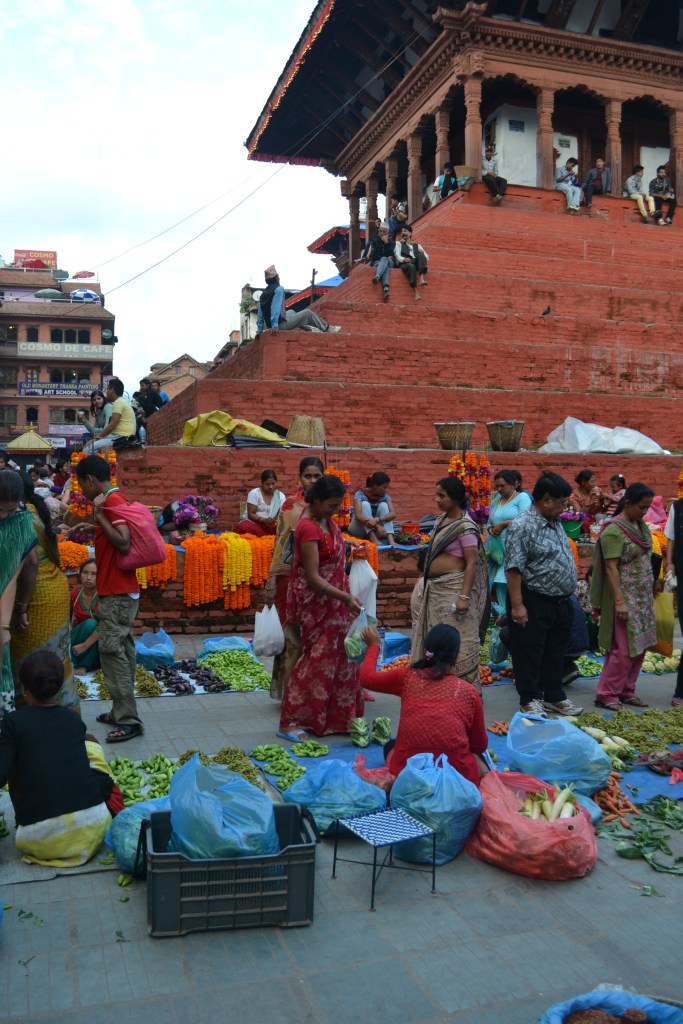
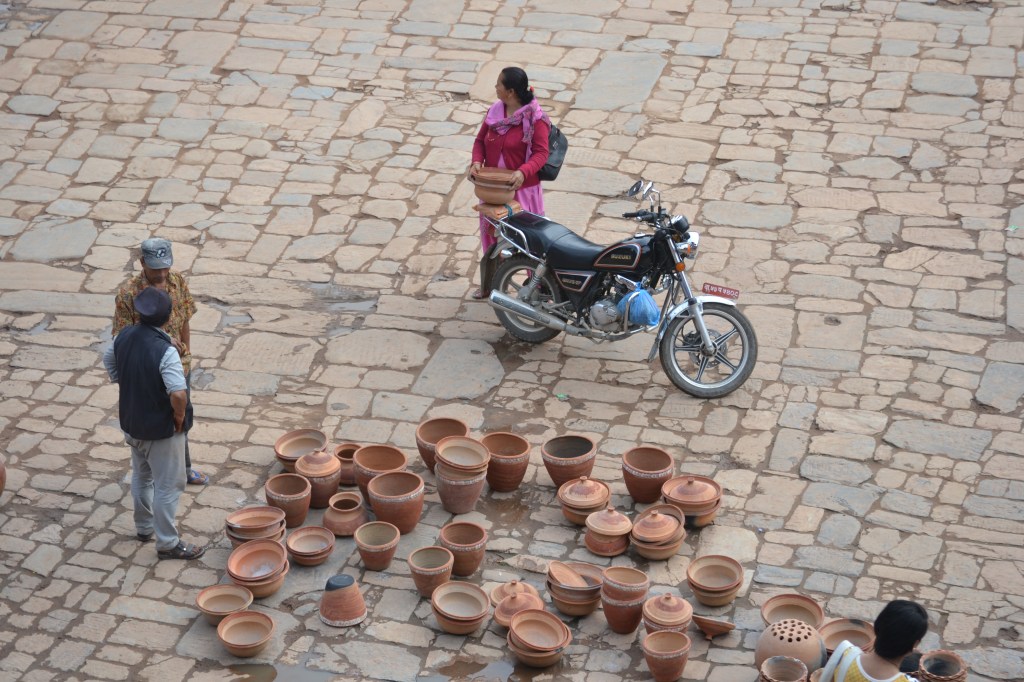
Another day we visited Durbar Square – sadly reduced to ruins in the earthquake that struck in 2015. The square is very impressive and contains many palaces and temples – all about 500 years old. All the roads leading into the square have officials positioned to try to charge foreigners an entrance fee. Unknowingly, the first time we visited we avoided paying, but we were not so lucky the second time.
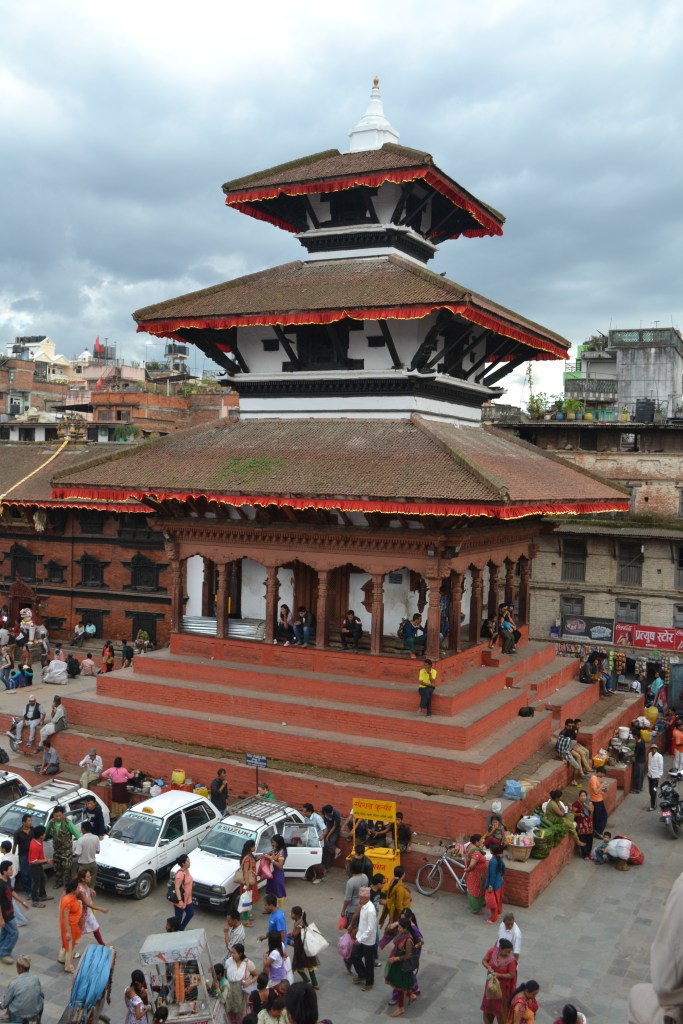
The best thing to do in the square was to climb up the sides of a temple and then sit watching the world go by. We happily did this for a whole afternoon, watching the market come and go while cows and dogs wandered around.
The cost of evening meals and tips were not included in our trek, and it is a little known fact that credit cards do not function over 4000m. Therefore we knew we had to take out cash – and quite a lot of it. So we headed for an ATM which we could not figure out how to use. So, for the first time in years, we entered a bank – sidestepping the armed guard outside. Once we got to the counter and explained what we wanted we were told to take a seat. Then we were taken to an office upstairs where we were able to get about £600 converted into Nepali Rupees. Clutching an enormous wad of bank notes we were acutely aware this amount was about 6 months’ salary for the average Nepali. And we were going to blow it on food in two weeks.
Another place we wanted to visit was Bhaktapur, a medieval city in the Kathmandu valley about 8 miles from the capital. We were very excited and proud to find our own way there by bus for about 7p each. The bus drops off at one end of the city and picks up from the other end, and you wander from one end to the other. Simple.
Bhaktapur was like an ‘old’ version of Kathmandu – if such a thing is possible. It was truly like travelling back in time (except for the motorbikes).
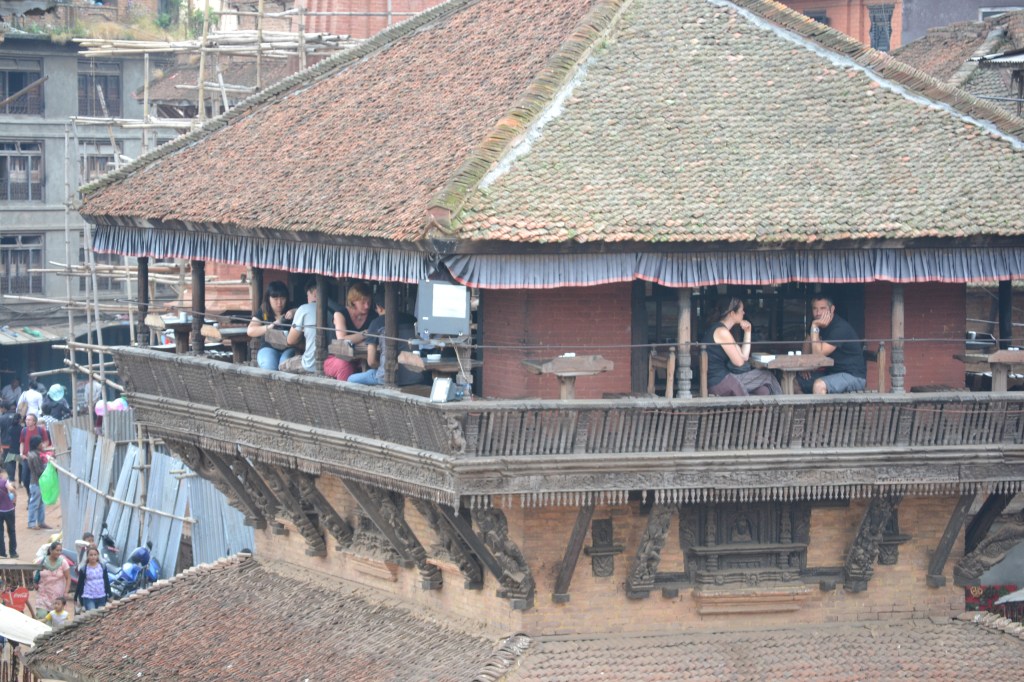
We had lunch in this restaurant, atop a temple. We were there mainly for the view. The menu was impenetrable and we ordered something – we did not know what. A tray of various types of offal – none of which we could identify – arrived and we duly left all of it and probably deeply offended the owners.
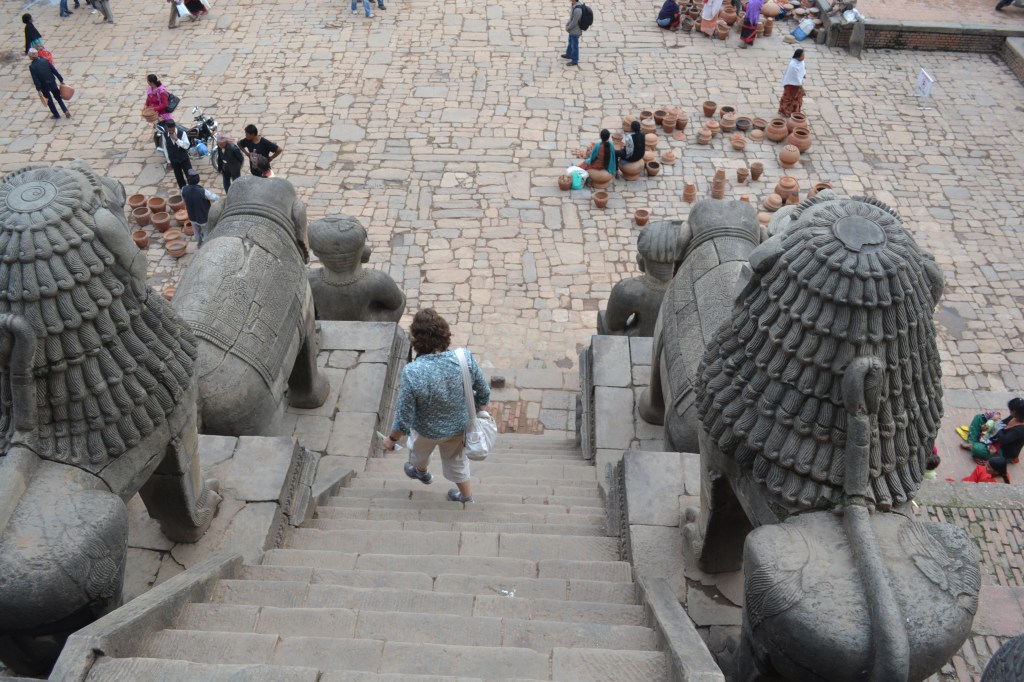
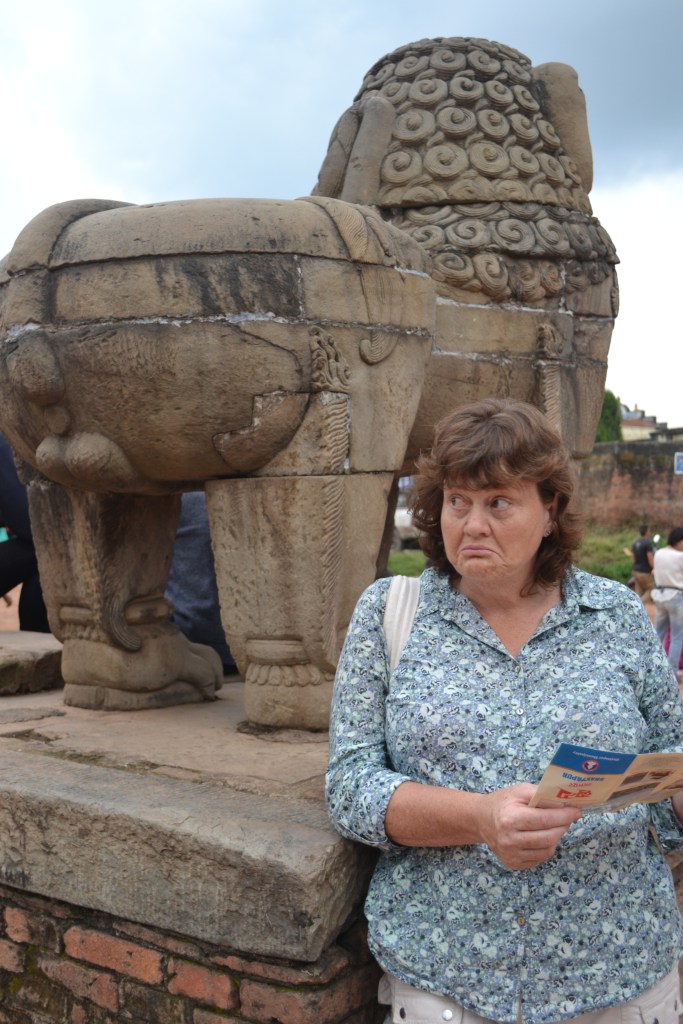
Bhaktapur also has a Durbar square – in fact most places do. It contained splendid statues of lions including this one displaying a very impressive set of testicles that Mary took a shine to.
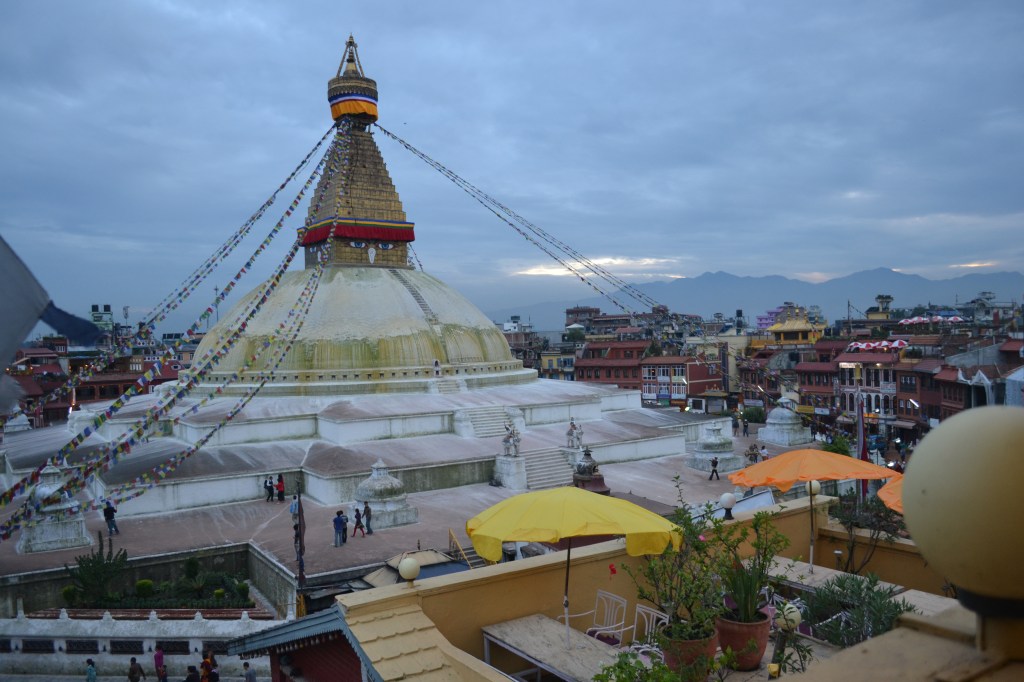
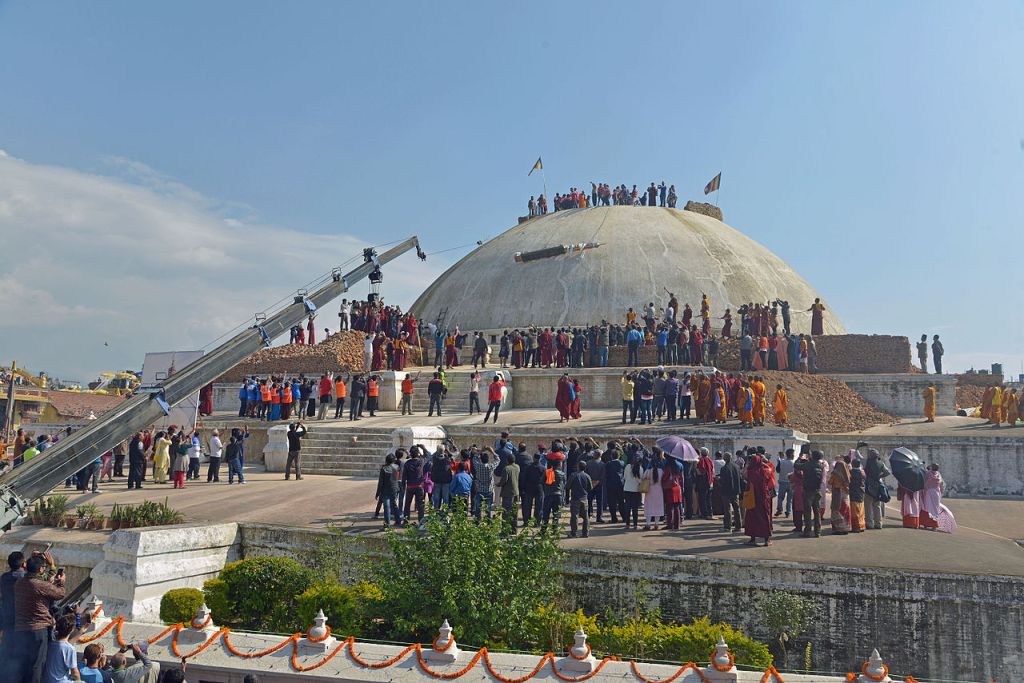
Another of the great sights in Kathmandu is Boudhanath Stupa, one of the biggest spherical stupas in the world. Every night at dusk locals gather and process clockwise around the stupa, while tourists such as ourselves sit on balconies overlooking the throng. We took a taxi there and obviously tipped so well the taxi driver was waiting for us 2 hours later when we emerged from the temple.
… and here’s a picture of the stupa being rebuilt after the 2015 earthquake.
Our final tourist destination of the week was the main Hindu temple in Kathmandu, Pashupatinath. I find Buddhist temples and rituals to be gentle, serene, mystical and friendly. But Hinduism, to me, is a bit scary. Our abiding memory of Pashupatinath was maybe a couple of hundred tourists sitting on terraces one side of the river watching Hindu funerals being carried out on the other side. The family carried the body and laid it on a pyre of wood which was then lit. The family would then walk around the fire, obviously praying. I don’t recall seeing any tears, maybe this is not a sad ceremony for them, but simply a pathway to the next life. While many people were taking pictures with their long lenses, it seemed to me too intrusive, so I do not have a photographic record.
 Everest Base Camp 2013